
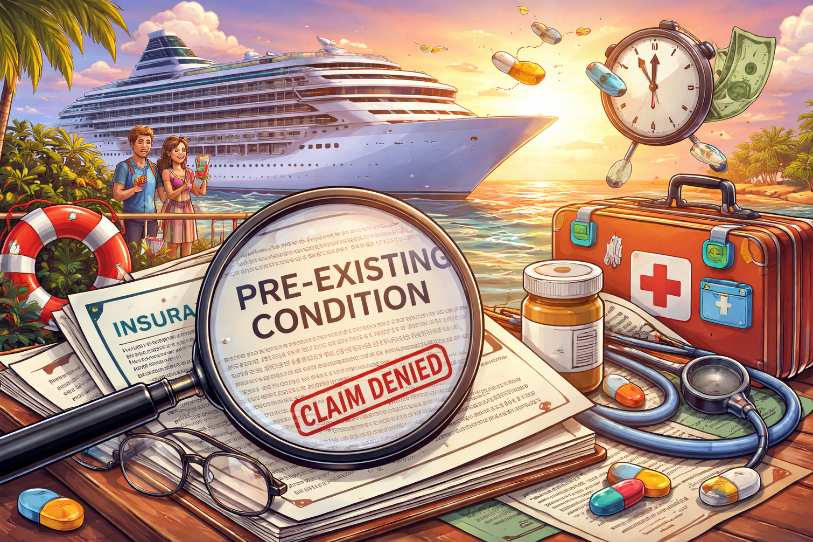
Understanding this single definition often matters more than choosing the fanciest cabin or remembering which fork handles dessert. When medical history meets maritime travel, details suddenly become very important—and occasionally very expensive.
What Counts as Pre-Existing
Insurers rarely limit the definition to dramatic hospital visits or major diagnoses. A condition can be considered pre-existing if symptoms appeared, medication changed, tests were scheduled, or a doctor simply suggested follow-up care within a specified window before purchasing the policy. Even something as mild as adjusting blood-pressure tablets can place a neat little asterisk beside future claims.This definition exists because insurers calculate risk using recent medical activity. From their perspective, a stable condition is predictable, while a recently changing one is a mystery novel with too many plot twists. Predictability gets coverage. Plot twists get scrutiny.
The Look-Back Clock Nobody Notices
Most policies include a “look-back period,” commonly ranging from 60 to 180 days before the insurance purchase date. During this time, any medical change connected to a future claim can trigger exclusion. Travelers often assume the clock starts at departure, which is a charming but incorrect belief.Timing matters. Buying insurance immediately after booking a cruise can shorten the practical risk window, while delaying purchase quietly extends it. The calendar, not the ocean, becomes the real force shaping protection. It is far less scenic but considerably more decisive.
Why Waivers Exist and Why They’re Picky
Many policies offer waivers that restore coverage for pre-existing conditions, but they behave like exclusive event invitations. Entry usually requires three things: purchasing insurance soon after the first trip payment, being medically fit to travel at that moment, and insuring the full non-refundable cost of the journey.Miss one requirement and the waiver politely disappears, leaving only standard exclusions behind. Nothing dramatic happens—no alarms, no flashing lights—just silence followed by an unpleasant surprise if a claim appears later. Insurance documents have mastered the art of calm disappointment.
Waivers reward decisiveness. Procrastination, despite being a beloved travel tradition, rarely earns similar generosity.
Why Claims Get Denied More Often Than Expected
Denied claims rarely hinge on dramatic technicalities. More often, the issue traces back to missing documentation, incomplete disclosure, or misunderstanding how broadly a pre-existing condition can be interpreted. If a traveler forgets to mention ongoing treatment—or assumes a stable illness “doesn’t count”—the insurer may view the omission as material, which is a formal way of saying the paperwork story and the medical story no longer match.Another frequent problem involves connecting dots after the fact. A chest infection at sea might seem unrelated to a prior respiratory condition on land, yet insurers evaluate medical linkage, not vacation optimism. When doctors reviewing a claim see continuity, coverage can quietly step aside. The ocean remains beautiful, but the reimbursement does not arrive with it.
Structuring Coverage So It Actually Works
Practical preparation reduces unpleasant surprises more effectively than hopeful thinking. Travelers can protect themselves by focusing on a few disciplined steps before departure rather than scrambling afterward.- Purchase insurance soon after the first trip payment to preserve eligibility for waiver provisions.
- Disclose all recent medical activity honestly, including medication adjustments and pending tests.
- Confirm medical stability with a doctor if any condition has fluctuated.
- Read the policy wording carefully enough to notice what is excluded, not just what is advertised.
Smooth Sailing Starts Before the Ship Moves
Cruises specialize in controlled environments—scheduled meals, organized excursions, neatly folded towels pretending to be wildlife. Medical risk refuses similar organization. Pre-existing conditions travel without packing lists and ignore buffet closing times. Insurance fine print is simply the attempt to impose order on that unpredictability.Reading those details may never compete with watching the horizon at sunset. Still, one activity protects the other. When coverage is arranged thoughtfully, travelers gain something more valuable than upgraded cabins or priority boarding. They gain the quiet confidence that if health decides to interrupt the itinerary, the financial aftermath will not become the longest journey of all.
Preparation, in this context, is less about fear and more about freedom—the kind that lets a person enjoy the ocean without wondering whether a line of small print is about to become the most memorable part of the trip.
Article kindly provided by cruiseinsurancequotes.com.au