
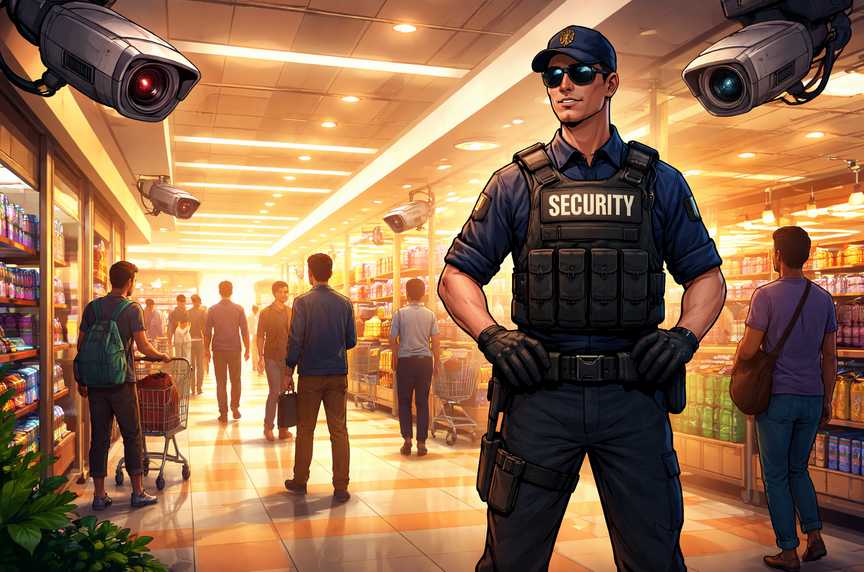
Surveillance systems have their place, and an important one. They document incidents, support investigations, and provide coverage across wide areas. Yet their influence is largely passive. A camera does not raise an eyebrow, adjust posture, or make brief eye contact with someone contemplating questionable behaviour. It simply observes, and often only after something has already begun.
By contrast, visible security operates in real time. It creates an environment where behaviour subtly shifts. People tend to stand a little straighter, reconsider impulsive decisions, and behave more in line with expected norms. Not because they are being watched in theory, but because they are being noticed in practice.
Behavioural Cues That Quietly Shape Decisions
Human behaviour is highly responsive to social cues, especially in shared environments. The presence of authority—particularly one that appears calm, alert, and approachable—acts as a behavioural anchor. It signals boundaries without needing to state them explicitly.This effect is not about intimidation. In fact, overly aggressive or overly rigid security can produce the opposite result, making customers uncomfortable or defensive. The goal is subtle influence rather than overt control. A professional presence communicates awareness, not hostility.
Consider how people behave differently in a tidy, well-managed environment compared to a neglected one. The same principle applies here. Visible security reinforces the idea that standards are maintained, and that actions have consequences. Even small signals—like a nod of acknowledgement or a brief greeting—can be enough to discourage disruptive behaviour.
And then there are those moments when someone debates whether to test the boundaries. That internal conversation often ends quickly when it is clear someone nearby is already aware of them. Cameras rarely win that argument. People do.
Strategic Placement Makes All the Difference
Where security personnel are positioned can significantly influence their effectiveness. Random placement tends to dilute impact, while deliberate positioning enhances both visibility and deterrence.High-traffic entry points are an obvious choice, but they are not the only important areas. Transitional spaces—such as corridors, escalator zones, and areas between departments—are often where behaviour shifts. These are the points where individuals feel less observed and more likely to take liberties.
Effective placement considers both visibility and flow. Security should be seen without obstructing movement or creating bottlenecks. A well-positioned officer can observe multiple angles, interact naturally with customers, and remain accessible without appearing intrusive.
There is also value in occasional movement. A static presence establishes a baseline, but periodic patrols introduce an element of unpredictability. People cannot simply adjust to a fixed pattern, which keeps behavioural standards more consistent across the space.
Done correctly, this creates an environment where customers feel guided rather than monitored. And importantly, where those considering less-than-ideal decisions feel just uncertain enough to reconsider.
Balancing Deterrence With a Welcoming Atmosphere
There is a fine line between reassurance and overbearing presence. Businesses that lean too heavily into enforcement risk creating an environment that feels tense rather than secure. On the other hand, a complete absence of visible authority can invite behaviour that slowly erodes the customer experience.The most effective approach blends professionalism with approachability. A security officer who can offer directions, assist with minor issues, or simply greet customers adds a human layer to the environment. This transforms security from a reactive function into an integrated part of the overall experience.
Customers tend to respond positively to individuals who appear confident but not confrontational. It turns out that a friendly “Can I help you?” carries far more influence than a silent stare from across the room. One feels like support. The other feels like a staring contest nobody asked to join.
Training plays a central role here. Communication skills, situational awareness, and emotional intelligence are just as important as procedural knowledge. A well-trained professional knows when to engage, when to observe, and when to intervene without escalating a situation unnecessarily.
Reducing Incidents Before They Begin
Preventative impact is where visible security truly stands apart. While surveillance systems excel at recording events, they do little to stop them from unfolding. Visible presence, on the other hand, often prevents incidents from happening in the first place.This reduction is not always dramatic or obvious. It shows up in fewer minor disturbances, less opportunistic behaviour, and a general sense of order that customers rarely think about—but immediately notice when it is missing.
From an operational perspective, fewer incidents mean less disruption, reduced strain on staff, and a more consistent customer experience. It also lowers the likelihood of escalation, which is where costs—both financial and reputational—tend to rise quickly.
There is also a subtle psychological effect on employees. Staff working in environments with visible security often feel more supported and confident. This can translate into better service, improved morale, and a greater willingness to address issues early rather than avoiding them.
When Cameras Watch and People Shape Behaviour
Surveillance and visible security are not competing solutions; they are complementary. Cameras provide coverage, documentation, and valuable insights. Visible personnel provide presence, interaction, and immediate influence.The key is understanding their roles. Cameras extend visibility. People define it. One records what happens. The other often determines whether it happens at all.
Businesses that rely solely on surveillance may find themselves with excellent footage and frequent problems. Those that incorporate visible security create environments where problems are less likely to occur in the first place. It is a quieter success, but a far more effective one.
And while a camera might capture someone making a questionable decision, it has yet to master the art of politely raising an eyebrow at just the right moment. That, it turns out, still requires a human touch.
Article kindly provided by globalforcesecurity.co.uk