
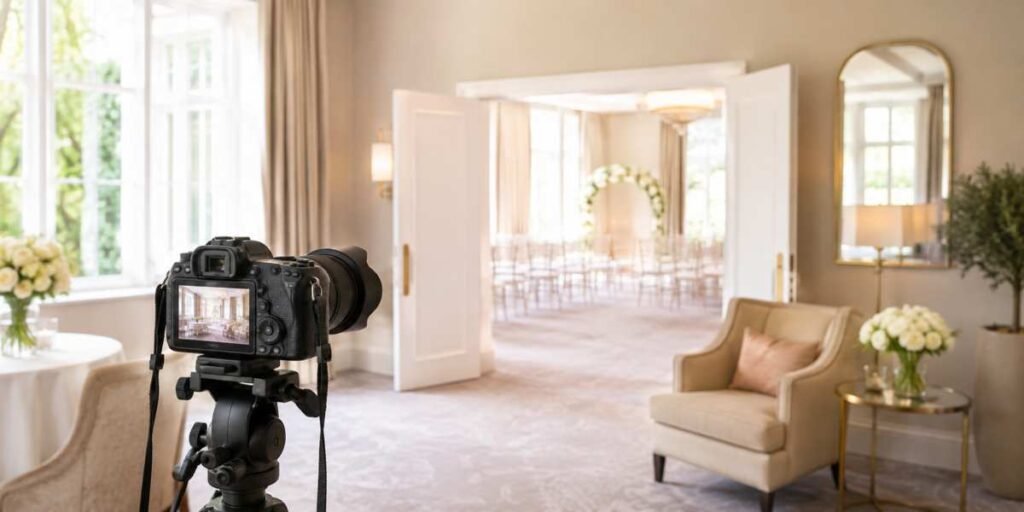
Wedding photographers spend hours examining properties from angles that hotel managers rarely consider. They notice where daylight falls at 10 a.m., which corridors create attractive backgrounds, where clutter accumulates and whether the bridal preparation room actually has enough space for six people, dresses, flowers, bags and somebody’s abandoned breakfast tray. Looking at a property through their eyes can reveal practical improvements that benefit both the wedding experience and the hotel’s marketing.
Lighting Looks Different Through a Lens
Hotel lighting is generally designed around what feels comfortable to guests. Wedding photography introduces another requirement entirely. A ceremony room might feel pleasantly atmospheric in person while appearing gloomy, uneven or oddly coloured in photographs.Mixed lighting is particularly revealing. Daylight coming through large windows combined with warm ceiling lights and decorative LEDs can create competing colour temperatures. Nobody attending the reception is likely to complain that Uncle Martin looks slightly orange, but the photographer editing 600 photographs afterwards may have stronger opinions.
Hotels can learn from this by examining professional wedding galleries taken throughout their property. Are certain rooms consistently photographed from one direction? Do photographers avoid particular corners? Are curtains routinely opened or lamps switched off? Repeated patterns may identify lighting problems that are invisible during normal operations.
Improving these areas does not necessarily require expensive renovations. Better bulbs, adjustable lighting zones, cleaner window areas and greater control over artificial lighting can make rooms more flexible for both photography and events.
Furniture Has a Surprisingly Large Supporting Role
Furniture placement often develops gradually. A chair moves because somebody needs access to a socket. A side table appears because there was nowhere else to put it. Six months later, everyone assumes the chair and table were ordained by the building’s architect.Photographs expose these accidental arrangements quickly. Large furniture can obstruct attractive architectural features, narrow useful shooting angles or make preparation rooms appear smaller than they actually are. Conversely, a well-positioned chair, mirror or occasional table can transform an otherwise ordinary area into an excellent location for portraits and detail photographs.
Hotels should therefore consider photographing important wedding spaces from several viewpoints rather than evaluating them solely by walking through them. The exercise can reveal unnecessary clutter and opportunities to create cleaner, more versatile backgrounds.
Signs Should Help Guests Without Joining Every Photograph
Signage is essential in hotels, especially when several events are happening simultaneously. Unfortunately, directional signs, fire notices, promotional displays and temporary conference boards have an impressive ability to appear directly behind important wedding moments.A useful review can identify which signs genuinely need permanent prominence and which could be repositioned, redesigned or temporarily moved during weddings. Good wayfinding should remain clear without turning every romantic photograph into an unexpected advertisement for the breakfast buffet.
Preparation Rooms Deserve More Attention
Preparation rooms are sometimes treated as functional spaces rather than an important part of the wedding experience. Yet photographers may spend several hours there before the ceremony, documenting dresses, suits, flowers, jewellery and the interactions between friends and family.A room that technically accommodates eight people can become remarkably small once eight people actually arrive. Add garment bags, makeup equipment, suitcases, photographers, videographers and several cups of coffee whose owners have vanished, and the available floor space rapidly disappears.
Hotels can improve these rooms by providing clear surfaces, accessible power sockets, useful mirrors, movable furniture and plenty of natural light. Neutral walls and uncluttered areas are particularly valuable because they give photographers flexibility without requiring the room itself to look deliberately designed as a photographic studio.
There is also a commercial advantage. Attractive preparation photographs show prospective customers considerably more than the ceremony and reception spaces. They demonstrate what staying and getting ready at the hotel actually feels like, helping couples imagine the complete experience.
Outdoor Spaces Need More Than Attractive Landscaping
A beautiful garden does not automatically make a practical wedding photography location. Photographers also notice where the sun will be, whether backgrounds contain parked cars, where guests naturally gather and whether there are sheltered alternatives when the weather decides not to respect the wedding schedule.Hotels can assess gardens, terraces and courtyards at different times of day. An elegant lawn at 9 a.m. may be exposed to extremely harsh sunlight by the time afternoon photographs are scheduled. A picturesque terrace may photograph wonderfully in one direction while the opposite angle reveals bins, delivery entrances or an industrial air-conditioning unit making an enthusiastic appearance behind the newlyweds.
Creating several usable outdoor areas gives photographers alternatives as light and weather change. Thoughtful planting, movable seating, discreet screening and clear sightlines can improve these spaces without fundamentally redesigning them.
Wedding Galleries Can Become a Property Audit
Hotels already receive enormous value from professional wedding photographs as marketing material, but those images can also be studied internally. Reviewing several complete galleries rather than simply selecting the prettiest photographs can reveal recurring strengths and weaknesses.Management teams can look for spaces photographers repeatedly use, areas they consistently avoid and background distractions that keep appearing. They can also identify unexpected photographic assets. A staircase, window, doorway or quiet corner may prove extremely popular despite never featuring prominently in the hotel’s own promotional strategy.
This information can then influence refurbishment decisions, wedding packages and future marketing shoots. Rather than guessing which parts of the property look impressive on camera, the hotel has evidence gathered during real events with real guests.
A Developing Picture
Wedding photographers effectively conduct repeated visual stress tests of a hotel. Their work reveals how spaces perform when crowded, decorated, photographed from unusual angles and used throughout changing daylight conditions.Hotels that pay attention to those photographs can make practical improvements that benefit couples, suppliers and staff while simultaneously creating stronger marketing material. Sometimes the most useful property consultant is already walking around the building carrying two cameras and wondering who decided that enormous plastic plant belonged beside the ballroom doors.
Article kindly provided by tomkeenanphotography.co.uk