
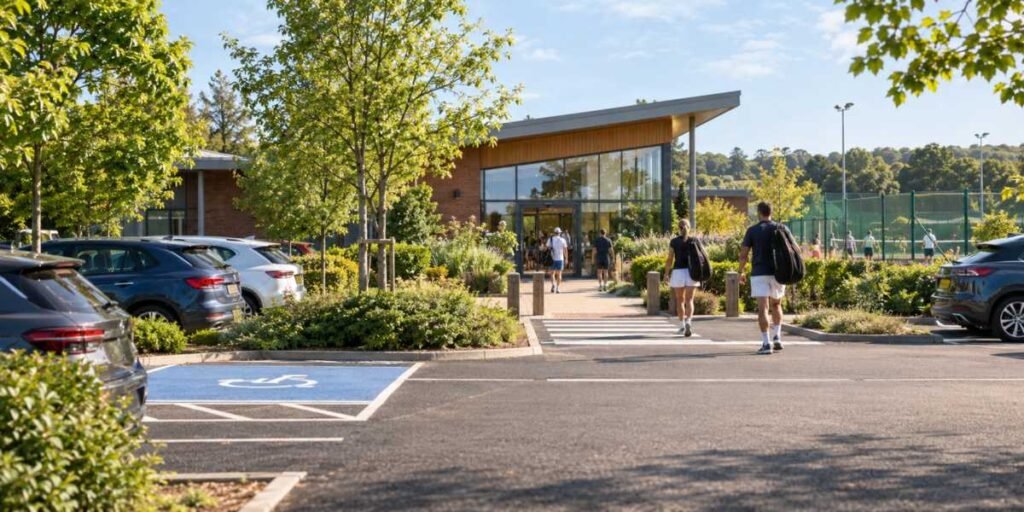
For clubs, leisure venues and tournament organisers, the arrival experience is not an administrative detail. It is the opening scene of the customer journey. A family attending a junior session, a prospective member visiting for the first time, or a business guest arriving for a hospitality event begins forming an opinion long before reaching the front desk. If the route from road to reception feels confusing, neglected or needlessly stressful, the organisation has already created work for itself.
Signage That Does More Than Exist
A sign is not necessarily useful merely because it has been installed. Faded lettering, arrows pointing in three directions at once, or a board tucked behind an enthusiastic hedge can turn a simple arrival into a small expedition. Visitors need clear guidance at the moments where they must make a decision: which entrance to use, where to park, how to find reception, and whether they are in the correct place.The best signs are easy to read while moving slowly in a car and remain helpful once people are on foot. They use consistent wording, obvious arrows and enough contrast to work in rain, darkness and the peculiar half-light of a winter afternoon. A club that calls its main entrance “Reception” on one sign, “Clubhouse” on another and “Members’ Lounge” online may be perfectly logical to long-standing members. To everyone else, it is a riddle with parking restrictions.
Consistency matters here because it builds quiet confidence. If the colours, typography and tone of the signs match the club’s digital communications, visitors receive a coherent message: this place is organised and knows what it is doing. That does not require an expensive redesign. It requires someone to view the approach as a newcomer would, rather than through the forgiving eyes of a person who has parked in the same corner for fifteen years.
Navigation Should Feel Effortless
The car park should answer practical questions before people need to ask them. Where are visitor spaces? Is there overflow parking for an event? Which route is safest for pedestrians? Where should coaches, suppliers or disabled visitors go? Clear routes reduce bottlenecks, prevent late arrivals and spare staff from repeatedly explaining that the entrance is “just past the little shed.”This is especially important when venues host several activities at once. A tennis lesson, a junior football fixture, a wedding reception and a committee meeting can produce a surprisingly complex traffic pattern. Marked bays, temporary event signs and a simple arrival plan on confirmation emails can make the difference between a welcoming venue and a slow-moving game of automotive Tetris.
Accessibility Begins at the Kerb
Accessibility should not start at reception. It begins with the route from vehicle to building. Disabled parking spaces need to be genuinely useful rather than symbolically close to a pothole, a steep kerb or an obstacle course of loose gravel. Paths should be sufficiently wide, well lit and clearly separated from vehicle routes wherever possible.For parents with pushchairs, older members, people carrying kit bags and visitors recovering from injury, these details are not cosmetic. They affect whether attendance feels manageable. A club can have excellent facilities inside while unintentionally making the first hundred metres the least welcoming part of the visit.
First Impressions Have Long Memories
A well-maintained car park does not need to resemble an airport forecourt. It simply needs to look cared for. Clear markings, working lights, tidy planting, sensible drainage and a visible place for litter all suggest that the same standard is likely to continue indoors. Conversely, overflowing bins, broken barriers and a collection of cones that appear to have formed their own governing body can make visitors wonder what else has been left unattended.This matters commercially. Prospective members often make decisions emotionally before they justify them rationally. They may not consciously think, “The directional sign uses a consistent visual identity.” They may simply feel comfortable, reassured and more inclined to return. For event organisers, sponsors and corporate guests, the effect is similar. A smooth arrival signals professionalism before any formal conversation begins.
Make the Physical and Digital Experience Agree
Many clubs invest time in an attractive booking system, polished social media posts and useful email communications, then leave visitors to decipher the final stage alone. The physical experience should follow the same logic as the digital one. If a booking email says to use the east entrance, the signs at the venue should use the same name. If the club advertises a family event, parents should be able to identify the most suitable parking area without conducting a reconnaissance mission.A practical review can focus on a few clear questions:
- Can a first-time visitor locate the correct entrance without telephoning?
- Are pedestrian routes clear, safe and usable in poor weather?
- Do signs use the same language as booking emails and online directions?
- Is event parking explained before visitors arrive?
- Would a person with limited mobility find the route practical?
Parking the Right Message
Treating the car park as part of the customer journey is not about polishing every bollard until it gleams. It is about recognising that people judge an organisation through the full experience it provides. A clear, safe and well-presented arrival helps members feel valued, reduces pressure on staff and gives events a more professional footing.When clubs make arrival easy, visitors can direct their attention towards the reason they came: playing sport, meeting people, supporting a team or doing business. That is a better use of everyone’s energy than circling the grounds for a fourth time while pretending it was entirely intentional.
Article kindly provided by woodandham.co.uk