
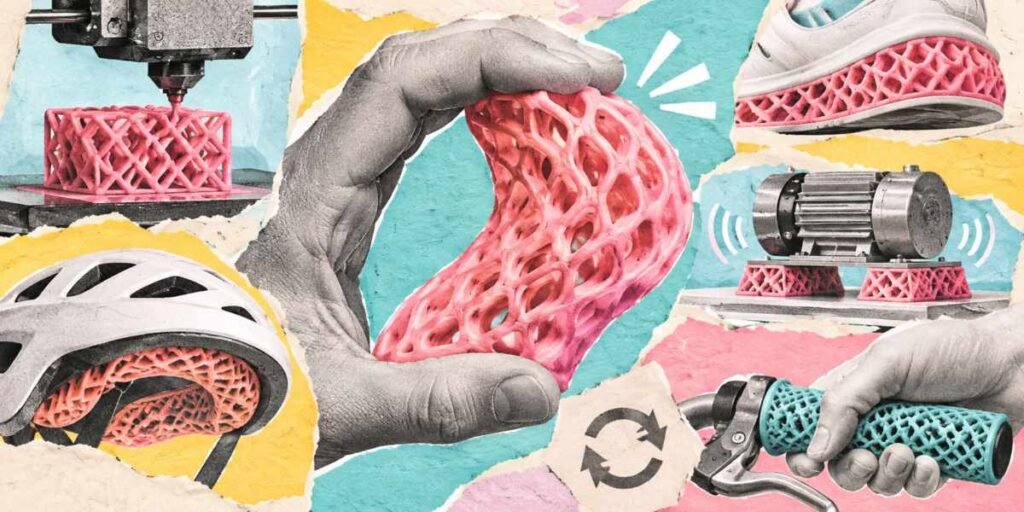
Traditional manufacturing often treats flexibility as a characteristic determined primarily by material choice. Rubber bends, steel resists, and concrete generally objects rather strongly to being stretched. Additive manufacturing introduces another possibility: designing flexibility directly into an object’s structure.
Materials With a Talent for Bouncing Back
Flexible 3D printing commonly relies on thermoplastic polyurethane (TPU) and other elastomeric polymers. These materials can stretch, compress and recover their shape, making them useful for components that must tolerate movement or repeated contact.However, not all flexible polymers behave identically. Some are relatively firm, offering controlled deformation, while others feel almost rubbery. Their hardness is frequently measured using the Shore scale, although hardness alone cannot describe every aspect of flexibility or resilience.
A soft material might stretch easily but tear under concentrated stress. Another might resist stretching yet perform exceptionally well when repeatedly compressed. Selecting the appropriate polymer therefore requires understanding exactly what the finished component will experience.
A protective phone case, for example, needs to absorb occasional impacts. A vibration-dampening mount must withstand thousands or millions of small movements. Asking one material to excel at both tasks without considering its properties is rather like hiring a trampoline to serve as a dining table.
Why Empty Space Can Make Something Stronger
One of the most interesting developments in flexible 3D printing involves lattice structures. Instead of producing a completely solid object, designers create interconnected networks of struts, cells or repeating geometric patterns.These structures contain carefully arranged empty spaces that allow controlled deformation. Under pressure, individual elements bend or buckle elastically, distributing forces throughout the component. When the load disappears, the structure can return towards its original configuration.
Different lattice geometries produce remarkably different mechanical responses. Honeycomb arrangements, gyroid structures and other repeating patterns can be adjusted to influence stiffness, energy absorption and compression behaviour.
Engineers can also vary cell sizes and wall thicknesses within a single component, producing regions with different levels of resistance. A custom cushion might have a softer centre surrounded by firmer supporting edges, despite being manufactured from one polymer.
This ability to control mechanical behaviour through geometry is particularly valuable when conventional foam or moulded rubber cannot provide the required combination of support, flexibility and shape.
Taking the Impact Without Taking the Damage
Protective equipment offers particularly promising applications for flexible 3D-printed structures. Helmet liners, sports padding and industrial protective components can incorporate geometries designed to absorb impact energy through controlled deformation.Unlike conventional cushioning, which often provides relatively uniform resistance, printed lattices can be tailored to particular pressure distributions. Areas exposed to greater forces might contain denser structures, while regions requiring comfort and ventilation can feature more open arrangements.
However, flexibility does not automatically guarantee protection. Materials must be tested under realistic impact conditions, including different temperatures, loading speeds and repeated impacts. A component that survives being squeezed enthusiastically by its designer might behave quite differently when struck by something travelling at considerable speed.
Making Vibrations Feel Unwelcome
Machinery generates vibrations that can cause noise, discomfort and premature component wear. Flexible printed mounts and dampeners can help manage these movements by absorbing and dissipating mechanical energy.Their effectiveness depends on several factors, including material damping characteristics, operating frequency and structural geometry. A component that successfully reduces high-frequency vibration might perform poorly against slower, larger movements.
Custom grips provide another practical application. Tool handles, bicycle grips and specialist equipment can incorporate flexible surfaces designed around individual hands or specific working conditions. Carefully positioned lattice regions can improve comfort while maintaining sufficient firmness for controlled handling.
For manufacturers producing small quantities of specialist equipment, this customisation can be particularly attractive because expensive moulds are unnecessary.
When Repeated Stress Becomes a Problem
A flexible component might survive its first hundred compressions beautifully before beginning to deteriorate. Repeated mechanical loading can cause fatigue, permanent deformation, cracking or gradual changes in stiffness.Printed parts also possess manufacturing characteristics that influence durability. Layer adhesion, printing orientation, internal defects and processing temperatures can all affect mechanical performance. Even a well-designed lattice may fail prematurely if its individual elements contain weak points.
Engineers therefore evaluate flexible components through cyclic loading tests, measuring how their properties change over time. Environmental conditions matter too. Exposure to ultraviolet radiation, moisture, oils or elevated temperatures can accelerate degradation in susceptible polymers.
Designing for longevity means considering not merely whether something bends, but how often, how far and under what conditions it must continue bending.
A Flexible Future With Plenty of Give
Flexible 3D printing challenges the assumption that stronger components must always be harder or more rigid. Sometimes the most effective engineering solution involves allowing an object to move, compress or temporarily change shape rather than resisting every applied force.As materials improve and structural design becomes increasingly sophisticated, applications could expand across medical devices, footwear, robotics and industrial manufacturing. The greatest opportunities may come from combining precisely controlled geometry with polymers selected for specific mechanical demands.
Ultimately, successful flexible design is about finding the right balance between movement and resistance. Too rigid, and a component may crack. Too soft, and it may collapse when support is needed. Get that balance right, however, and even something resembling a miniature plastic mattress can become a remarkably sophisticated piece of engineering.
Article kindly provided by i-am3d.com