
Logistics Before the First Truck Arrives
Large commercial concrete projects rarely begin with concrete. They begin with spreadsheets, scheduling calls, equipment checks, and a calendar that looks like it was attacked with a highlighter. Warehouses, parking areas, and multifamily developments depend on enormous flatwork pours, and those pours operate on a timeline that leaves very little room for improvisation.Concrete is a material that does not negotiate. Once it leaves the truck, the clock starts ticking. That simple fact drives almost every logistical decision made before the first drop of material reaches the site.
Contractors map out staging zones for trucks, pumps, and finishing crews days or even weeks in advance. Access routes are reviewed carefully so a line of ready-mix trucks can enter, unload, and exit without turning the jobsite into a slow-moving parade of confused drivers. No one wants a thirty-ton truck trying to reverse through a maze of rebar and temporary fencing while a foreman stares at his watch.
Timing also matters because suppliers must coordinate with the crew on site. Ready-mix plants schedule delivery windows down to tight intervals. Too early, and the crew is scrambling. Too late, and the pour sequence falls apart. A gap of thirty minutes between trucks can feel like an eternity when an entire slab depends on a continuous flow.
Planning covers the smaller details too. Weather forecasts are checked obsessively. Forms are inspected. Subgrades are compacted and graded with care. When hundreds or thousands of square feet of concrete are about to be poured, discovering a problem halfway through is about as welcome as rain during a roof installation.
Staging the Jobsite Like a Well-Planned Operation
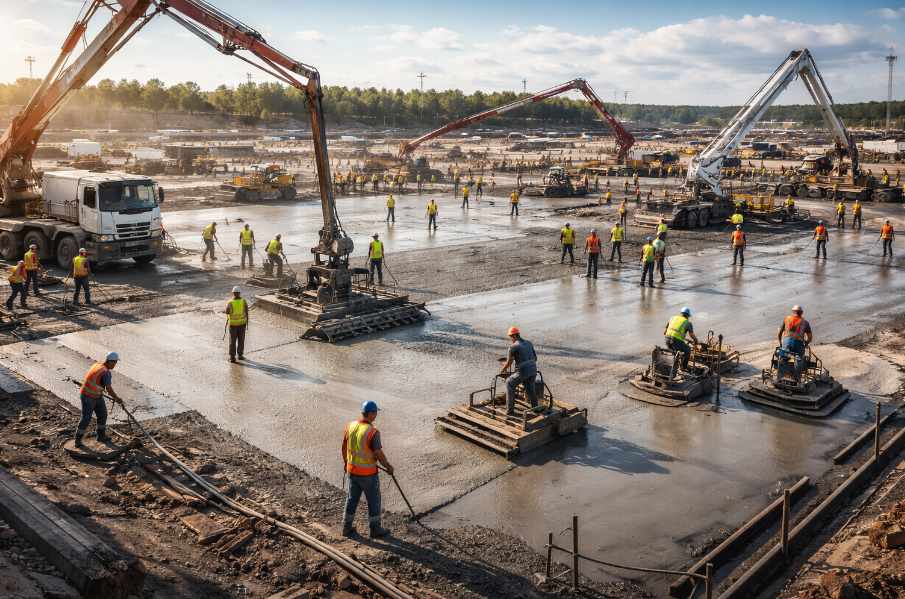
A large pour looks chaotic to an outsider. Trucks roll in one after another. Workers move quickly across a wide slab. Equipment hums, vibrates, and occasionally complains loudly. Beneath that activity, however, is a tightly organized staging plan.Material, tools, and machinery must be positioned so crews can work without delays. Concrete pumps are placed where they can reach the entire pour zone without constant repositioning. Finishing tools are organized near access points. Vibrators, screeds, and power trowels are staged where they will be needed next, not where they were used last.
Crew coordination becomes especially important on expansive slabs. Different teams handle different responsibilities at the same time.
- Placement crews guide the concrete into forms.
- Screed operators level the surface immediately behind them.
- Finishers move in once the surface begins to firm up.
- Quality supervisors monitor consistency and timing.
Clear communication keeps the process flowing. Radios, hand signals, and a surprising amount of shouting all serve a purpose. Construction sites may not resemble quiet libraries, but the messages being passed around are precise. Timing is everything, and everyone on the slab knows it.
Sometimes a supervisor simply walks the slab with a focused look that says, without a single word, “Let’s keep moving.” Surprisingly effective management technique.
Curing Timelines and the Clock Nobody Can Pause
Concrete might look calm once it is poured, but a quiet chemical reaction is already underway. Hydration begins immediately, and the curing timeline becomes the next scheduling challenge. Contractors cannot rush curing, but they must plan everything around it.Temperature, humidity, and wind all influence how quickly concrete gains strength. In hot weather, crews may apply curing compounds quickly or cover the slab to slow moisture loss. In colder conditions, insulation blankets or heated enclosures sometimes appear across the site. These measures are not optional details; they protect the structural integrity of the slab and ensure the project can move forward on time.
Finishing crews watch the surface carefully during the early curing phase. Power trowels may glide across the slab multiple times, gradually refining the surface as it stiffens. The timing of each pass matters. Too early and the surface becomes messy. Too late and the concrete resists the effort like a stubborn door that refuses to budge.
Meanwhile, the project schedule keeps moving. Other trades are waiting for the slab to reach certain strength thresholds. Steel framing crews, wall installers, and equipment contractors all depend on those numbers. Testing cylinders and field measurements help confirm when the slab is ready for the next stage.
Nobody on the project enjoys hearing the phrase “we need to wait another day,” but structural reliability wins that argument every time.
Specialized Equipment Keeps the Schedule Moving
Large commercial pours rely heavily on machinery designed specifically for scale. Without the right equipment, even the most organized crew would struggle to maintain momentum across massive slabs.Concrete pumps are often the first critical piece of equipment on site. These machines deliver material precisely where it is needed, especially when the pour area stretches far beyond the reach of trucks. Boom pumps extend overhead like mechanical arms, placing concrete with impressive accuracy.
Laser screeds are another powerful tool. These machines level concrete with remarkable precision across large surfaces. Instead of relying entirely on manual screeding, operators guide the equipment while sensors maintain consistent elevation. The result is a smoother surface and faster progress.
Power trowels, both walk-behind and ride-on models, handle the finishing work that gives warehouse floors and parking structures their final surface. On expansive slabs, ride-on machines resemble small vehicles gliding across fresh concrete while operators carefully refine the texture. It is one of the few construction tasks where someone technically spends the day driving in circles and calls it productive.
Support equipment plays its part as well. Vibrators remove trapped air. Survey tools confirm elevations. Lighting systems allow pours to continue safely when schedules demand early mornings or late evenings.
Each machine reduces delays, improves consistency, and helps crews maintain the pace required for large commercial builds.
Solid Plans Make Solid Slabs
Behind every successful commercial pour is careful coordination that began long before concrete reached the site. Scheduling deliveries, positioning equipment, organizing crews, and managing curing conditions all combine to keep massive flatwork projects on track.When everything works properly, the result appears deceptively simple. A smooth slab stretches across the site, ready for the next phase of construction. Workers pack up equipment, supervisors review the results, and the job quietly advances toward completion.
Of course, getting there required hundreds of decisions, plenty of planning, and more than a few cups of strong coffee shared during early morning briefings.
Concrete may harden slowly, but the organization behind it moves quickly. And when that organization holds together, entire developments rise from a surface that started as a carefully timed pour.
Article kindly provided by colinconcretedesmoines.com