
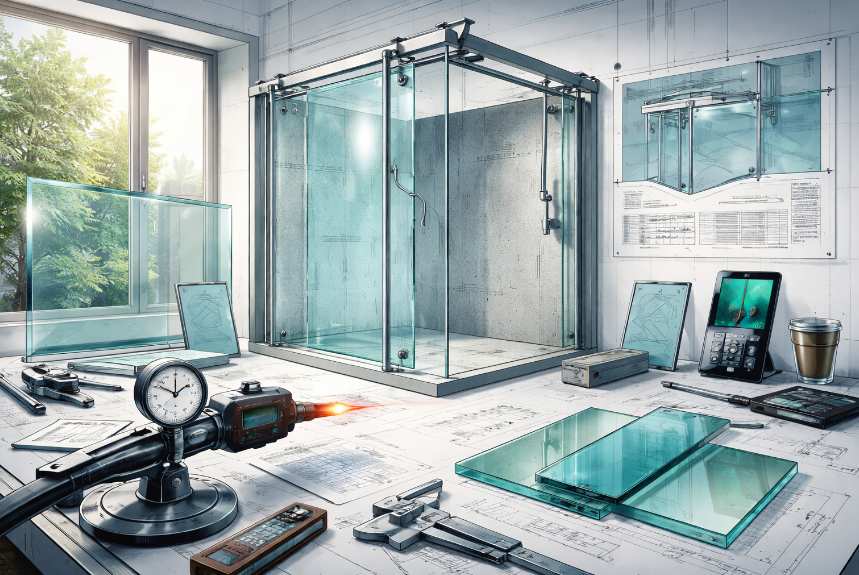
Specifying architectural glass, especially in wet areas, sits at an intersection of aesthetics and engineering. The clarity and minimalism clients want are often achieved by pushing materials closer to their limits than many realise. When those limits are misunderstood, problems don’t politely wait—they arrive loudly, usually with a crack.
Glass Type Is Not Interchangeable
Not all glass is created equal, even if it looks identical once installed. Toughened (tempered) glass is widely used for its strength and safety characteristics. When it fails, it breaks into small granules rather than dangerous shards. Laminated glass, on the other hand, holds together when fractured due to its interlayer.In wet environments, the choice between these isn’t simply about preference. It’s about risk management and intended performance. Toughened glass offers strength but can fail suddenly if compromised. Laminated glass provides redundancy, often staying in place even after impact.
A common oversight is assuming one can be swapped for the other without consequence. That assumption tends to surface later, usually when someone asks why a panel didn’t behave as expected. The answer is rarely comforting.
Thickness Is Doing More Work Than It Gets Credit For
Glass thickness is often treated as a line item rather than a structural decision. Yet thickness directly influences deflection, perceived stability, and resistance to impact.In frameless applications, thickness becomes even more critical because there’s less structural support to compensate. A thinner panel may meet minimum requirements but still flex enough to feel unsettling. That slight movement might not be a failure in engineering terms, but it can quickly become a failure in client confidence.
There’s also the matter of scale. Larger panels demand greater thickness, not just for strength but to maintain visual integrity. Nobody wants a beautifully designed space where the glass behaves like it’s auditioning for a trampoline.
Edges Are Where Problems Begin
The weakest point of any glass panel is its edge. This is where chips, micro-cracks, and stress concentrations tend to form. Edge finishing—whether polished, arrissed, or otherwise treated—is not decorative. It is protective.Improperly finished edges increase the likelihood of failure, especially in high-moisture environments where thermal expansion and contraction are constant factors. Add in the occasional accidental knock during cleaning or maintenance, and those tiny imperfections start to matter a lot.
There’s a particular irony in projects where every visible surface is meticulously specified, yet edge treatment is left vague. The result is a flawless face paired with a vulnerable perimeter—a bit like wearing a suit of armour with open sides.
Specifiers who pay attention to edge detailing tend to avoid the kind of callbacks that begin with “it just shattered on its own.” Glass rarely acts without reason, even if it appears dramatic about it.
Support Systems Define Performance More Than Appearance
Minimal hardware often gets applause in design reviews. It keeps lines clean, reduces visual clutter, and photographs beautifully. Unfortunately, glass does not care about applause. It cares about load paths, fixings, and how forces are transferred through the system.Support systems—whether channels, brackets, or discreet hinges—determine how stress is distributed. Poorly specified supports can introduce point loads that exceed the material’s tolerance, even when the glass itself is correctly chosen. This is where elegant designs quietly develop structural headaches.
There are a few recurring trouble spots worth noting:
- Inadequate fixing into substrates that were never designed to carry glass loads
- Over-reliance on minimal hardware without compensating increases in thickness
- Misalignment during installation, introducing unintended stress
Compliance Is Not a Box to Tick
Regulatory standards for glass in wet areas exist for a reason. They cover safety glazing requirements, load resistance, and installation practices. Treating them as a checklist rather than a framework often leads to borderline decisions that pass inspection but fail in practice.Compliance should guide specification, not follow it. This means considering how components interact as a system rather than verifying each element in isolation. A compliant glass panel paired with a poorly executed fixing detail is still a liability.
Documentation also matters. Clear specifications reduce ambiguity on site, which in turn reduces improvisation. And while improvisation has its place in some industries, structural glazing is not one of them.
Small Decisions, Expensive Consequences
Many failures in architectural glass installations do not stem from dramatic miscalculations. They emerge from small compromises—slightly thinner glass, a less precise edge finish, a fixing detail that “should be fine.”Individually, these choices may appear harmless. Combined, they can create conditions where failure becomes likely rather than possible. When that happens, the consequences extend beyond replacement costs. There are delays, reputational damage, and the uncomfortable task of explaining preventable issues.
On the flip side, getting these details right rarely draws attention. A well-specified installation performs quietly, without incident, which is precisely the point. Glass, at its best, disappears into the design while doing a considerable amount of structural work behind the scenes.
Clear Thinking Beats Clear Glass
Architectural glass rewards precision and punishes assumption. Type, thickness, edge finishing, and support systems are not independent decisions; they are interdependent variables that define performance.Specifiers who approach glass with an engineering mindset tend to avoid surprises. Those who treat it as a purely visual element often end up learning more about stress fractures than they ever intended.
Clarity in design is admirable. Clarity in specification is essential.
Article kindly provided by caledora.glass