
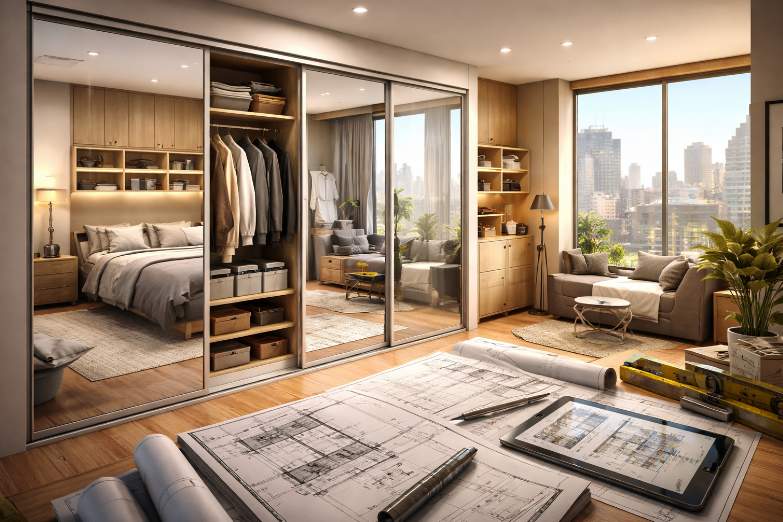
Why Sliding Door Logic Matters in Dense Housing
Urban housing has a way of turning every square metre into a small political argument. The kitchen wants room to breathe, the bathroom refuses to shrink any further, and storage is left trying to squeeze itself into whatever space survives the negotiations. That is exactly why sliding door principles deserve more attention in residential development and fit-out planning.Traditional hinged doors are demanding things. They require clearance, interrupt circulation, and can make a compact bedroom feel like it is constantly bracing for impact. Sliding doors, by contrast, work within the footprint already available. They remove the swing arc, reduce wasted movement space, and allow storage systems to sit more comfortably in tighter floorplans. For developers and architects working on urban schemes, that is not a minor design detail. It is a planning advantage.
The benefit goes beyond visual neatness. A well-designed sliding storage system can improve the practical function of a room without increasing its size. In apartments where bedroom dimensions are carefully controlled, that extra usability matters to occupants and to sales teams trying to justify value per square metre. Good storage does not rescue a weak layout, but it can make a disciplined layout feel far more intelligent.
Layout Optimisation Starts Before the Joinery Package
Sliding door storage works best when it is considered early, not squeezed into the project after every other decision has already planted its flag. When architects coordinate storage zones during the planning stage, they can align wall depths, circulation paths, and furniture placement with greater precision. The result is a cleaner room geometry and fewer compromises later in the build process.This is especially important in high-density developments where bedrooms often need to accommodate multiple functions. A room may serve as a sleeping area, a dressing space, and a remote working corner, all while attempting to remain recognisably human. Sliding door systems support that balancing act because they allow wardrobes to sit closer to beds, desks, and walkways without creating operational conflicts.
There is also a specification advantage. Early coordination gives contractors and interior teams a clearer framework for track placement, ceiling interfaces, floor tolerances, and panel widths. That reduces awkward site improvisation, which is usually where costs rise and tempers become expressive.
Track Systems That Keep Everything Moving
Sliding doors may look effortless once installed, but their performance depends heavily on what is happening behind the scenes. Track systems are not just a technical detail; they are the difference between a smooth, quiet glide and a daily reminder that something was value-engineered a little too enthusiastically.For large-scale developments, consistency is key. Ceiling-mounted tracks can create a cleaner visual line and reduce floor interruptions, which is useful in accessible design scenarios. Floor-supported systems, on the other hand, can offer additional stability for heavier panels, particularly when using glass or mirrored finishes. The right choice depends on structural conditions, material selection, and the expected level of use.
Specifiers also need to think about durability over time. Residents tend to interact with wardrobe doors more often than they expect, and not always with the gentlest touch. A robust track system with quality rollers and soft-close mechanisms can prevent long-term maintenance issues and reduce post-completion complaints. Nobody enjoys explaining to a client why their storage solution sounds like it is warming up for takeoff.
Material Selection and Visual Integration
Sliding door systems offer a surprising amount of flexibility when it comes to materials, and that flexibility can be used strategically across a development. Panels can be designed to blend seamlessly with surrounding walls, reflect light to enhance perceived space, or introduce contrast for a more defined interior character.Common options include:
- Mirrored panels that amplify natural light and make compact rooms feel less confined
- Matte finishes that reduce glare and align with contemporary design schemes
- Wood-effect surfaces that bring warmth without the cost or maintenance of solid timber
- Glass inserts that add a sense of depth while maintaining a clean aesthetic
Integrating Sliding Storage into Modern Schemes
Sliding door storage should feel like part of the architecture, not an afterthought that was politely added just before handover. When integrated well, it can reinforce clean lines, support minimal layouts, and contribute to a more cohesive interior language across a development.This integration often comes down to proportion and alignment. Matching door heights with ceiling lines, coordinating panel divisions with wall features, and aligning finishes with adjacent elements can elevate the overall result. These details may seem small individually, but together they create a sense of intention that is difficult to fake.
For developers, this level of integration can translate into stronger buyer perception. Storage that feels considered rather than improvised signals quality, even in compact units. It suggests that the design team has paid attention to how people actually live, rather than simply fitting components into available gaps.
Sliding into Smarter Living
Efficient storage in urban housing is rarely about adding more space. It is about using existing space with greater precision and less friction. Sliding door principles offer a practical route toward that goal, helping projects deliver functionality without sacrificing layout clarity.When thoughtfully specified and properly integrated, these systems can reduce spatial conflict, improve usability, and support a more refined living environment. They also tend to age better than solutions that rely on constant adjustment or careful choreography to avoid collisions. In a setting where every centimetre matters, that quiet reliability is not just convenient. It is essential.
Article kindly provided by bedroomsplusonline.co.uk