
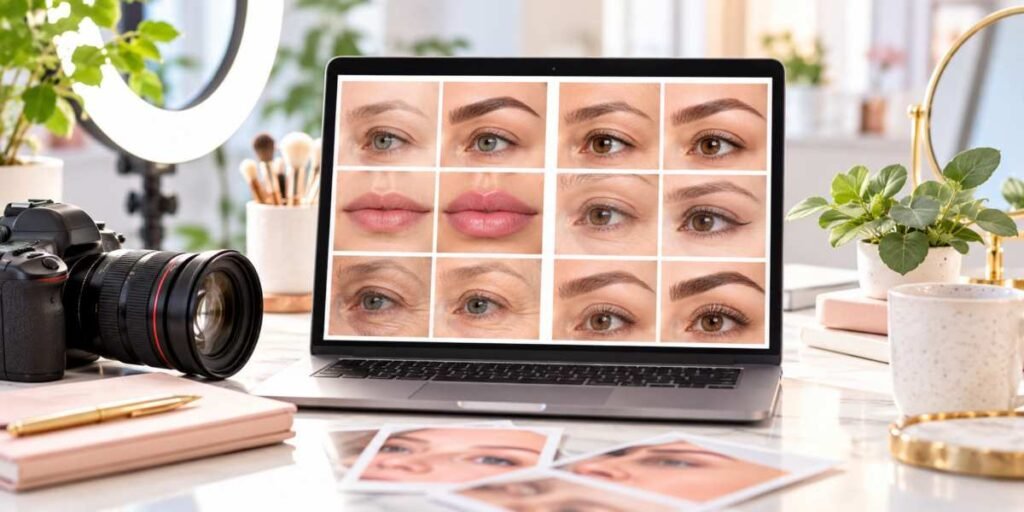
Before-and-after photography has become an essential part of marketing for beauty businesses. Whether the work involves permanent makeup, skin treatments, brows, lashes or other specialist services, prospective clients naturally want evidence. They want to see what a practitioner can actually do. The problem is that photographs can become so polished that they stop providing useful evidence and start behaving more like advertising illustrations.
A credible portfolio should certainly make work look attractive. More importantly, however, it should help someone make an informed decision.
Consistency Beats the Occasional Masterpiece
Almost any established practitioner can eventually accumulate a handful of spectacular photographs. If hundreds of clients pass through a business, there will inevitably be especially photogenic faces, unusually cooperative skin and results that seem destined for Instagram before the treatment chair has stopped revolving.Prospective clients need to know whether those examples represent normal standards rather than exceptional victories. A stronger portfolio therefore shows breadth: different ages, skin types, facial structures and treatment requirements. Twenty consistently good results can say considerably more about professional ability than three astonishing ones.
Businesses should also resist quietly retiring every photograph that looks less than editorial. A technically successful treatment performed on ordinary skin under ordinary circumstances may actually be more informative to a prospective client than the photograph that looks ready to launch its own cosmetics range.
Make the Camera Behave Itself
Standardised photography is one of the simplest ways to improve credibility. Before and after images should ideally use the same camera, distance, angle, background and lighting conditions. Facial expressions should also remain reasonably consistent. Comparing a tired, expressionless “before” photograph with a smiling, beautifully posed “after” photograph proves mainly that smiling works.Lighting deserves particular attention. Harsh overhead illumination can exaggerate texture and shadows, while soft frontal lighting can make skin appear dramatically smoother. Neither is inherently dishonest, but changing between them makes comparison difficult.
A practical photography area with fixed lighting and a marked position for the client can remove much of this variation. Businesses can develop a repeatable process rather than conducting a miniature fashion shoot every time somebody needs a photograph.
Fresh Results Are Only Half the Story
Immediately completed treatments often photograph beautifully, but they do not necessarily represent the eventual result. Permanent makeup provides an obvious example. Colour, definition and surrounding skin can change substantially during healing, making a photograph taken immediately after treatment useful but incomplete.Where possible, portfolios should distinguish clearly between fresh and healed results. Better still, businesses can document both. This gives prospective clients a more realistic understanding of the process while demonstrating that the practitioner remains confident enough in the work to photograph it after time has passed.
Healed photographs may lack some of the instant visual drama of freshly completed work, but commercially they can be more persuasive. They answer the question that really matters: not simply “How did it look when the client left?” but “How did the work actually settle?”
Permission Is Part of Professionalism
A client agreeing to a treatment does not automatically mean agreeing to become part of the business’s marketing department. Photographs should be taken and published only with appropriate permission, with clients understanding where their images may appear.A clear consent process protects both parties. Businesses should explain whether photographs could be used on websites, social media, printed materials or training resources and maintain a reliable record of that permission. Clients should never feel that declining photography will affect the treatment or the way they are regarded.
There is also a useful commercial lesson here. Respecting someone’s privacy can strengthen trust considerably. A client who does not want her eyebrows appearing online between a lunch photograph and somebody’s holiday in Tenerife has made a perfectly reasonable request.
Document the Difficult Work Too
A particularly credible portfolio can include cases that required more thought than a straightforward treatment. Corrective work, asymmetry, faded previous treatments, challenging skin or unusual client requirements can demonstrate judgement as well as technical skill.Context matters. A short explanation can describe the client’s objective, relevant limitations and the approach taken without turning the portfolio into a medical dossier. This helps prospective clients understand why particular decisions were made rather than judging every result against a single fashionable aesthetic.
Beauty businesses should also avoid presenting work as their own when several practitioners were involved. If an existing treatment was corrected, refreshed or partly retained, say so. Professional credibility is difficult to build and remarkably easy to damage once prospective clients suspect that the portfolio has been playing creative games with reality.
Filters Belong Somewhere Else
Retouching creates an obvious credibility problem. Removing temporary redness may seem harmless, but once editing starts smoothing skin, altering colour or sharpening treatment boundaries, the photograph is no longer an accurate record of the service.Beauty businesses are in an unusual position because their photographs are simultaneously marketing material and evidence of workmanship. That makes restraint valuable. Basic cropping and consistent exposure correction can improve presentation without changing the underlying result. Face reshaping, skin smoothing and beauty filters should stay firmly out of the portfolio.
There is something faintly magnificent about demonstrating a skin treatment by digitally removing the client’s skin texture afterwards, but it rather defeats the investigative purpose of the exercise.
Putting the Best Face Forward
The strongest portfolio is not necessarily the one containing the most flawless faces. It is the one that allows prospective clients to understand what the business repeatedly achieves under realistic conditions.That means consistency in photography, clear identification of fresh and healed results, proper client permission and enough variety to demonstrate genuine experience. It also means accepting that reality sometimes contains pores, redness, uneven lighting and human beings who do not naturally pose like cosmetics models.
For beauty businesses, honest documentation can itself become a competitive advantage. Clients increasingly encounter highly processed imagery and know that photographs can be manipulated. A portfolio that feels systematic, transparent and believable therefore communicates something beyond technical skill: professional confidence.
Before-and-after photographs should not require prospective clients to become forensic investigators. When the lighting matches, the conditions are explained and the results are allowed to speak for themselves, the portfolio stops merely saying “look how good this looks” and starts providing something considerably more valuable: evidence.
Article kindly provided by permanentmakeupagatha.com