
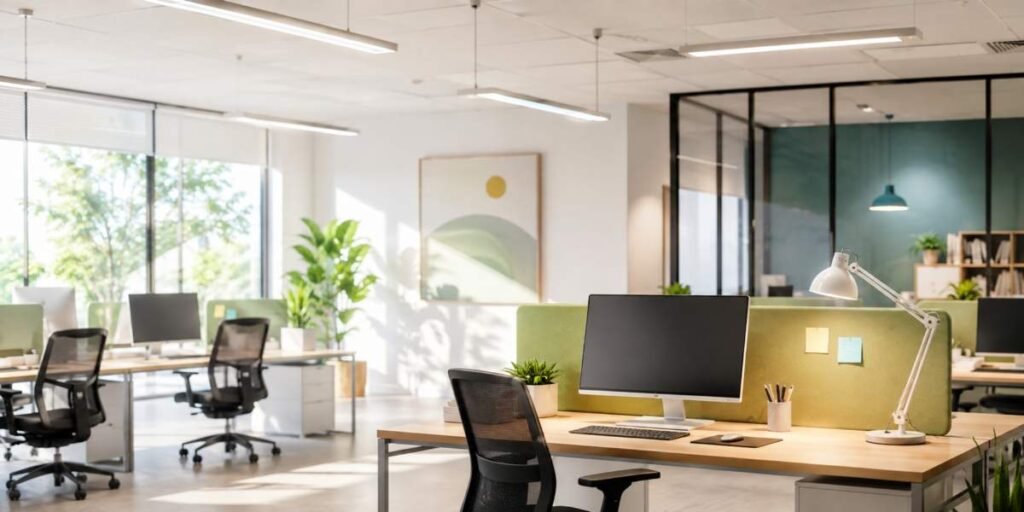
Poor office lighting often works quietly because its effects are easy to blame on something else. Fatigue may be attributed to a heavy lunch, reduced concentration to a dull task and headaches to excessive screen use. Yet the light surrounding a workstation can intensify all three, gradually reducing comfort and productivity without becoming the obvious suspect.
Glare Makes Every Screen Harder to Read
Glare occurs when a bright light source competes with the object a person is trying to see. It may come directly from an exposed fixture or indirectly from light reflecting across a monitor, polished desk or glass partition. Even mild glare can force the eyes to keep adjusting throughout the day.Employees may respond by leaning forward, changing posture, squinting or increasing screen brightness. These small adaptations often happen unconsciously, but they demand effort. By mid-afternoon, the workstation begins to feel less like a place of employment and more like an interrogation room designed by someone with shares in an electricity company.
Fixtures should be positioned so that they do not shine directly into employees’ eyes or create strong reflections on screens. Monitors can also be turned away from windows or bright fittings. Anti-glare screens may help, although correcting the direction of the light is usually more effective than placing another layer of plastic between a person and their spreadsheet.
Uneven Illumination Creates Hidden Strain
An office does not need to be dark to be poorly lit. Uneven illumination can be equally tiring. One desk may sit beneath a powerful ceiling fixture while another occupies a gloomy corner where every document looks as though it contains state secrets.Moving repeatedly between bright and dim areas forces the eyes to adapt. This is particularly noticeable in offices where strong daylight enters through one side of the room while interior workstations rely entirely on artificial light. The contrast may look architecturally interesting for five minutes, but it becomes less charming after several hours of concentrated work.
A better approach is to create balanced background lighting throughout the office and then provide adjustable task lighting where extra brightness is needed. This gives employees more control without turning the entire room into a showroom.
Colour Temperature Influences Concentration
Not all white light feels the same. Colour temperature plays a surprisingly important role in how comfortable an office feels over the course of a working day. Very warm lighting can create a relaxed atmosphere that suits hospitality spaces, while extremely cool lighting may feel clinical and uncomfortable if overused.Many offices achieve better results with a balanced neutral white light that supports alertness without making the room feel harsh. The goal is not to imitate an operating theatre or a candlelit restaurant. Most people simply need lighting that allows them to work comfortably without constantly noticing it.
Consistency also matters. Mixing several colour temperatures in the same open-plan office can produce a strangely uneven appearance. One department may look as though it belongs in a cosy café while another resembles a laboratory. Unless someone is conducting tax returns in one room and delicate surgery in the next, keeping colour temperatures reasonably consistent generally creates a calmer working environment.
Fixture Placement Is More Important Than Many Realise
Installing high-quality light fittings does not automatically guarantee excellent results. Placement is just as important as the fixtures themselves. Lights positioned directly above computer monitors, behind employees or at awkward angles can introduce shadows and reflections that reduce visual comfort.Workstations should be planned alongside the lighting layout rather than squeezed into available spaces afterwards. Small adjustments in desk orientation can dramatically reduce reflections, while carefully positioned fittings help distribute light more evenly across work surfaces. Even moving one ceiling fixture during an office refurbishment may improve dozens of workstations throughout the room.
Natural daylight deserves equal attention. Windows provide excellent illumination, but without suitable blinds or shading, bright sunlight can overwhelm screens during certain parts of the day. A gentle balance between daylight and artificial lighting usually produces the most comfortable conditions.
Simple Improvements Can Deliver Noticeable Results
Improving office lighting does not always require a complete redesign or an expensive renovation. Many workplaces can benefit from relatively straightforward changes that immediately improve comfort and concentration.- Replace ageing lamps that have gradually lost brightness.
- Choose LED fixtures that provide even illumination with good colour rendering.
- Reposition desks to minimise glare from windows and ceiling lights.
- Install adjustable task lighting for employees performing detailed work.
- Clean light fittings regularly, as accumulated dust quietly reduces light output.
Bright Ideas That Really Work
Lighting should support work rather than compete with it. When glare is reduced, illumination becomes more even, colour temperature is chosen carefully and fixtures are positioned thoughtfully, offices become noticeably more comfortable places to spend the day. Employees are better able to focus, visual fatigue is reduced and ordinary tasks require less effort. Good office lighting rarely attracts compliments because it simply allows people to get on with their work. Ironically, that quiet invisibility is perhaps the brightest compliment it can receive.Article kindly provided by cplights.com