
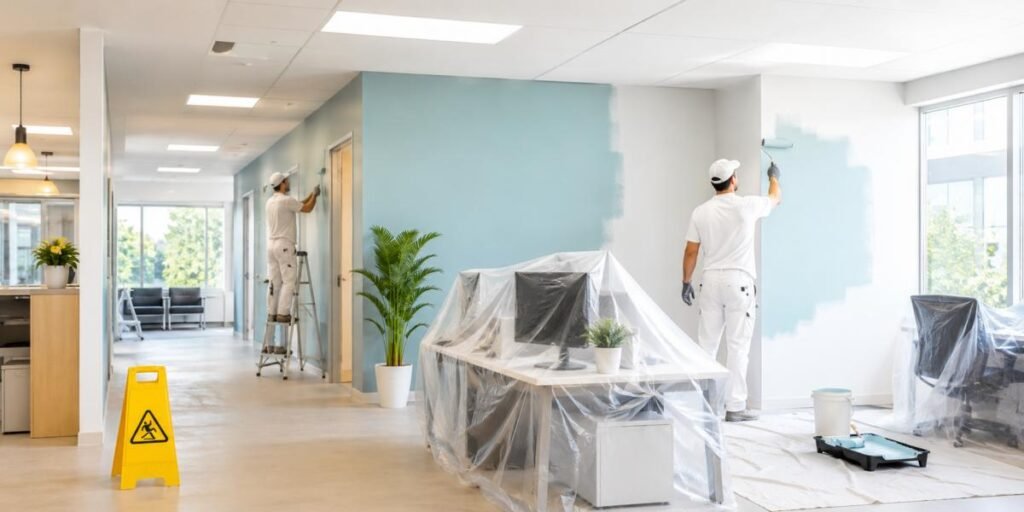
That makes planning just as important as brushes, rollers and paint. Offices, shops, warehouses and other working environments rarely offer the luxury of simply closing for several days while decorators take over. Instead, the project needs to fit around the business rather than expecting the business to fit around the project.
Divide the Property Into Workable Zones
Trying to repaint an entire commercial property simultaneously creates unnecessary disruption. A phased approach allows individual areas to be completed, reopened and returned to normal before work moves elsewhere.An office might be divided by department or floor, while a shop could be tackled section by section. Warehouses can often be separated into operational zones, particularly where stock movements and vehicle routes are predictable.
The important point is to identify which areas depend upon one another. Painting a corridor might sound straightforward until somebody realises it is the only route to the staff toilets. Suddenly, what looked like a decorating decision has become a minor logistical crisis.
Schedule Around the Way the Business Actually Operates
Commercial painting schedules should reflect real working patterns rather than simply normal office hours. Some areas may be busiest first thing in the morning, while others remain virtually unused until later in the day. Shops may have quiet weekdays but extremely busy weekends. Warehouses can have particular loading periods when restricting access would cause serious problems.Mapping these patterns beforehand makes it easier to decide when each area should be painted. Where practical, disruptive work can be scheduled for evenings, weekends or planned shutdown periods.
It is also worth allowing proper drying time before reopening an area. A timetable that assumes employees can return immediately after the final roller stroke may look wonderfully efficient on paper, right up until somebody parks a filing cabinet against a wall that is still tacky.
Protect Equipment Before Anything Starts
Computers, machinery, shelving, stock and furniture all need consideration before painting begins. Moving items away from walls is usually preferable where space permits, while anything remaining nearby should be properly covered.Sensitive equipment may require more protection than an ordinary dust sheet. Preparation work such as sanding can create fine particles, while accidental splashes have a remarkable ability to locate precisely the piece of equipment everyone hoped would remain spotless.
Clear responsibility should also be established beforehand. Staff need to know what they must move, what contractors will protect and which areas need to remain completely untouched.
Keep Customers Away From the Wet Paint
Customer-facing businesses require another layer of planning because disruption cannot simply be explained away as an internal inconvenience. Access routes should remain obvious, entrances need to stay presentable and customers should never have to negotiate ladders, equipment or freshly coated door frames to reach the counter.Temporary signs and barriers can redirect foot traffic while particular sections are being completed. For larger properties, it may be possible to alternate entrances or close individual corridors without affecting the rest of the premises. Retailers can also move displays temporarily, allowing painters to complete one section before merchandise returns.
Communication matters here. Staff should know which areas are restricted and how long restrictions are expected to remain. Otherwise, the carefully planned barrier around a newly painted wall will inevitably be moved by somebody who has decided that reaching the stationery cupboard takes precedence over everything else.
Save the Awkward Jobs for After Hours
Not every painting task creates the same level of disruption. A quiet meeting room may be straightforward to tackle during working hours, whereas reception areas, staircases, main corridors and loading entrances are considerably more complicated.These high-traffic locations are often good candidates for evening or weekend work. The same applies to areas where furniture must be moved extensively or where preparation will create noise and dust. Completing the awkward sections while the building is quiet can prevent a relatively simple decorating job from becoming an elaborate exercise in human traffic control.
Businesses should also consider ventilation. Paint products vary considerably, but even modern low-odour coatings can be noticeable when used across a large area. Scheduling substantial internal work when fewer people are present gives rooms more time to ventilate before employees and customers return.
Build Some Flexibility Into the Plan
A commercial repaint should have a schedule, but that schedule should not be treated as sacred scripture. Unexpected deliveries arrive. Meetings are rearranged. A supposedly empty room suddenly becomes essential because somebody has invited twelve clients for a presentation and neglected to tell anyone.Allowing some flexibility makes it possible to move work between areas without losing an entire day. Regular communication between painters, facilities managers and relevant staff also helps small problems get resolved before they become operational headaches.
For larger projects, it can be useful to review progress at the end of each phase. Lessons learned from the first floor, department or warehouse zone can then improve the next one.
A Brush With Disruption
Repainting an operational commercial property does not have to mean choosing between shabby walls and shutting the doors. The most successful projects treat decorating as a logistical exercise as much as a maintenance job.Phased scheduling, sensible access arrangements, careful protection and strategic out-of-hours work can keep disruption surprisingly small. Employees can continue working, customers can continue buying and warehouse operations can keep moving while the premises gradually receive their new finish.
The objective is simple: when the project is complete, people should notice the improved surroundings rather than spend the following month swapping stories about the week they had to climb over three desks to reach the kettle.
Article kindly provided by imperialpaintersgoldcoast.com.au