
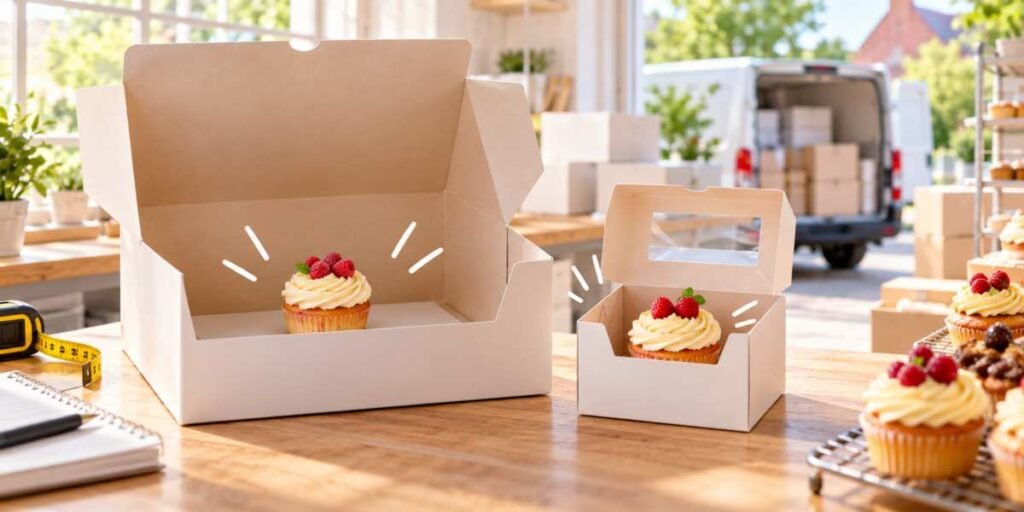
A few unnecessary centimetres might seem insignificant when examining a single box. Multiply those centimetres across several thousand orders, however, and the financial implications become considerably harder to ignore.
Paying for Air Without Realising It
Packaging suppliers generally calculate prices according to material requirements, manufacturing processes and order quantities. Larger cardboard boxes usually require more material, which can increase their individual cost. Although the difference between two sizes might amount to only a few pennies, commercial purchasing operates on multiplication rather than sentiment.Consider a bakery purchasing 40,000 boxes annually. If choosing a slightly smaller specification saves five pence per box, the annual saving reaches £2,000. That money could fund equipment maintenance, staff training or a considerable quantity of emergency chocolate.
Oversized packaging can also increase expenditure on tissue paper, inserts and other protective materials used to prevent products from moving. Businesses sometimes find themselves buying additional packaging simply to compensate for the unnecessary space inside their original packaging.
When Storage Space Becomes an Expensive Luxury
Commercial kitchens rarely suffer from an embarrassing abundance of spare storage. Ingredients, equipment, cleaning supplies and finished products already compete for available shelving. Bulky packaging introduces another contestant into this increasingly crowded competition.Flat-packed boxes still occupy valuable space, particularly when businesses maintain numerous sizes. Larger dimensions can reduce the number of units stored on each shelf or pallet, while assembled boxes consume considerably more room.
For smaller bakeries operating from expensive high-street premises, inefficient packaging storage can become a genuine operational problem. Staff may spend additional time retrieving stock, rearranging shelves or navigating towers of cardboard that appear to be developing their own planning ambitions.
Reviewing packaging dimensions alongside storage arrangements can reveal opportunities to consolidate stock, improve accessibility and reduce the frequency of deliveries.
Delivery Vehicles Have Limits Too
Delivery costs are influenced by vehicle capacity, journey frequency and the number of orders transported. Oversized packaging reduces the quantity of products that can fit safely inside a delivery vehicle, potentially requiring additional journeys during busy periods.For businesses using courier services, parcel dimensions may also affect shipping charges. Some carriers calculate prices using volumetric weight, meaning a lightweight but unnecessarily large parcel can cost more to transport than its actual weight would suggest.
Carefully selected packaging dimensions help businesses make better use of vehicle space without stacking delicate products dangerously or compromising food safety.
Giving Cakes Room to Move Is Not Always Generous
Excessive space inside packaging can increase the likelihood of products shifting during transportation. Cakes, pastries and decorated desserts are particularly vulnerable to sudden movement, especially when delivery drivers encounter potholes, sharp corners or motorists apparently auditioning for Formula One.A box that fits its contents appropriately provides greater stability, reducing the risk of damaged decorations, displaced toppings and crushed edges. However, excessively tight packaging creates different problems, including contact with delicate icing and difficulty removing products safely.
The objective is to establish suitable clearance around each product while allowing for protective inserts where necessary. Businesses should test packaging with actual finished goods rather than relying exclusively on measurements taken from baking tins.
Measure Twice, Order Several Thousand Once
Accurate product measurement is an important step towards improving packaging efficiency. Bakeries should record the maximum length, width and height of finished products, including decorations, toppings and any supporting boards.Measurements should also account for natural variations between batches. A handmade celebration cake might not have precisely the same dimensions every time, particularly when decorative elements are added individually.
Before committing to bulk purchases, businesses can trial several packaging sizes using representative products. Testing should include packing, carrying, stacking where appropriate and removing the contents. A box that looks perfect on a supplier’s specification sheet might prove remarkably uncooperative when confronted with a generously iced Victoria sponge.
Fewer Sizes Can Mean Greater Efficiency
Standardising packaging dimensions can simplify purchasing and inventory management. Rather than maintaining a separate box specification for every individual product, businesses can group items according to similar dimensions and handling requirements.For example, several varieties of pastry might share one packaging format, while different cake designs could use another. This approach can reduce the number of stock lines, improve purchasing consistency and make staff training easier.
Standardisation should remain flexible enough to accommodate unusually shaped products, seasonal ranges and delicate decorations. The intention is not to force every baked item into the same cardboard accommodation, but to eliminate unnecessary variations that provide little practical benefit.
Thinking Inside the Box
Efficient packaging does not require sacrificing presentation. Well-proportioned boxes can actually improve the customer experience by keeping products secure and creating a more deliberate, professional appearance.Businesses should review packaging costs periodically, particularly when product ranges, delivery arrangements or order volumes change. Comparing dimensions, storage requirements, protective materials and transportation costs provides a more complete picture than examining the purchase price alone.
Ultimately, empty space is not always wasted space. Some products genuinely need additional clearance for protection and presentation. The important distinction is between space that serves a purpose and space that simply consumes money. For commercial bakeries operating on tight margins, understanding that difference can turn an overlooked packaging detail into a worthwhile operational improvement.
Article kindly provided by thecakeboxes.co.uk