
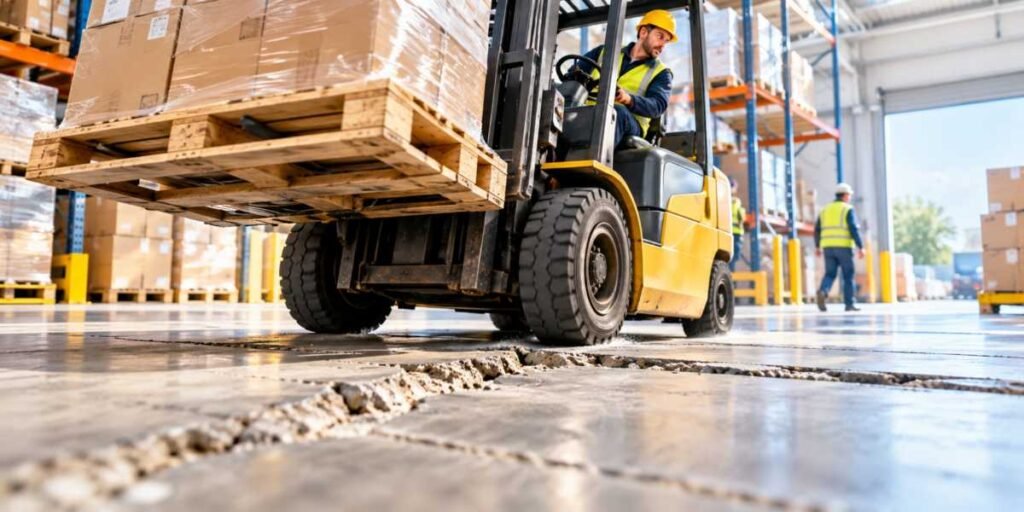
A warehouse floor might appear perfectly serviceable to someone walking across it. However, machinery operating repeatedly over the same surface can expose imperfections that are barely noticeable to the human eye. What begins as a slight dip or raised concrete joint can eventually become an expensive operational problem.
When Millimetres Start Costing Money
Modern warehouses depend on predictable movement. Forklifts, pallet trucks, reach trucks and automated handling equipment perform best when travelling across surfaces that meet their operational requirements. Even relatively small irregularities can interfere with that predictability, particularly where vehicles operate at height or carry substantial loads.An uneven floor may force forklift operators to reduce speed, adjust their routes or exercise additional caution when transporting goods. Individually, these interruptions appear insignificant. Across hundreds of journeys every day, however, the lost minutes accumulate.
Consider a distribution centre operating twenty forklifts, each making dozens of journeys during a shift. If deteriorating floor conditions add just fifteen seconds to forty journeys per vehicle, the business loses more than three hours of combined operating time daily. Multiply that across an entire year, and the concrete has effectively appointed itself an additional employee whose principal responsibility is slowing everyone else down.
The financial consequences extend beyond labour costs. Reduced handling speeds can affect loading schedules, order fulfilment targets and the overall capacity of the facility.
Forklifts Remember Every Bump
Warehouse vehicles are designed for demanding environments, but their components are not immune to repeated impacts and vibration. Uneven surfaces can accelerate wear on tyres, wheels, bearings and suspension-related components where fitted, particularly when equipment repeatedly crosses damaged joints or sunken sections of concrete.Solid forklift tyres provide durability but offer limited cushioning compared with conventional pneumatic tyres. Consequently, irregularities in the floor can transmit substantial vibration through the vehicle and its load.
Over time, this additional mechanical stress may contribute to increased maintenance requirements, premature component replacement and unexpected equipment downtime.
Operators also experience the consequences. Repeated jolting and whole-body vibration can contribute to fatigue and physical discomfort, especially during long shifts. Employers have a responsibility to assess these occupational risks and implement appropriate controls.
Replacing worn components without addressing the underlying floor defects can become an expensive exercise in treating symptoms rather than causes. The maintenance department might appreciate the job security, but the finance department is unlikely to share its enthusiasm.
When Automation Meets Imperfection
Automated warehouses introduce another dimension to the problem. Autonomous mobile robots, automated guided vehicles and sophisticated storage systems depend on accurately controlled movement. Floor irregularities that barely inconvenience a conventional forklift can interfere with equipment designed to operate within narrow tolerances.Some automated systems require particularly flat surfaces to maintain positioning accuracy, traction and reliable load handling. Unexpected changes in floor elevation may trigger navigation errors, emergency stops or repeated operational interruptions.
These problems become especially expensive when automated equipment forms part of an interconnected logistics operation. One vehicle stopping unexpectedly can interrupt several downstream processes, creating delays that extend well beyond the original obstruction.
Investing millions in warehouse automation while ignoring the condition of the concrete beneath it is rather like buying a precision Swiss watch and using it to hammer nails.
Damaged Goods and Dangerous Surprises
Uneven floors can also threaten inventory. Sudden jolts may destabilise palletised loads, damage fragile merchandise or cause poorly secured goods to shift during transportation. Where high-value electronics, glass products or precision components are involved, even occasional incidents can become financially significant.Employee safety presents an equally important concern. Uneven pedestrian routes create potential trip hazards, while unexpected vehicle movement can increase the risk of collisions or falling loads. These dangers become particularly serious in busy facilities where forklifts and pedestrians operate close together.
Businesses should therefore regard floor maintenance as part of their wider workplace safety programme rather than merely a cosmetic consideration.
Finding Trouble Before Trouble Finds You
Facilities managers can begin by identifying areas where operational problems repeatedly occur. Forklift routes, loading bays, high-traffic intersections and narrow-aisle storage areas deserve particular attention.Regular inspections should look for sunken slabs, raised joints, cracking, surface deterioration and signs of movement. Maintenance records can provide valuable clues, particularly when recurring vehicle repairs or damaged goods appear concentrated around particular warehouse locations.
For more detailed assessments, specialist contractors can measure floor flatness and levelness using appropriate surveying equipment. The relevant tolerances depend on the type of warehouse operation, with some specialised handling systems requiring considerably tighter specifications than conventional storage facilities.
Repair priorities should reflect operational risk. A small defect on a heavily travelled forklift route may deserve more urgent attention than a larger imperfection in an infrequently used storage corner. Depending on the cause and severity, suitable remedies might include joint repairs, localised grinding, slab stabilisation or concrete replacement.
Keeping Logistics on the Level
Warehouse floors rarely attract attention when everything works properly. They receive considerably more scrutiny when vehicles break down, deliveries fall behind schedule or employees suffer avoidable injuries.Treating concrete surfaces as essential operational infrastructure allows businesses to move beyond reactive repairs. Regular inspections, sensible maintenance budgets and timely corrective work can protect equipment, improve productivity and reduce disruption.
Ultimately, a warehouse floor should support the movement of goods rather than become another obstacle in the supply chain. Keeping operations on the level is not simply a matter of good housekeeping. It is good business.
Article kindly provided by cuttingedgefoundationrepairs.com