
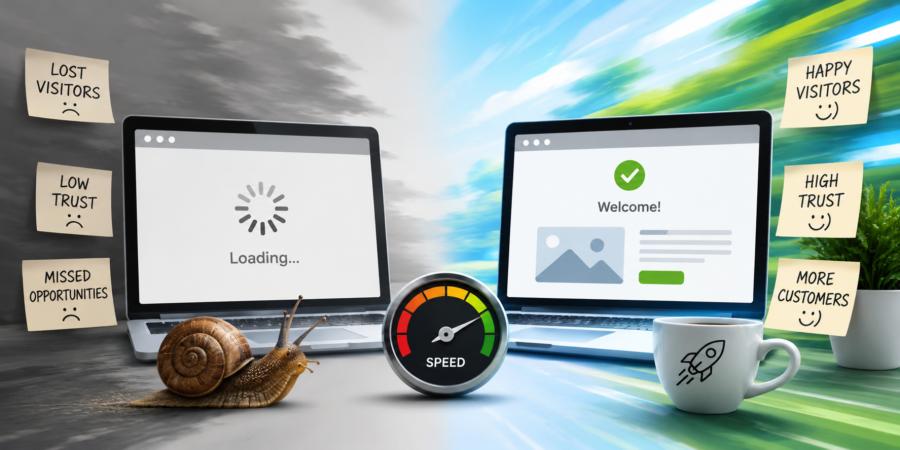
People rarely announce that they are judging a website. They simply do it. Within seconds of arriving, visitors begin making quiet decisions about credibility, professionalism, and trustworthiness. These decisions are not always logical, and they are certainly not fair. Yet they happen all the same.
A slow website creates suspicion before a single sentence is read. Visitors may not know whether the issue comes from oversized images, sluggish hosting, or code behaving like it negotiated a longer lunch break. What they do know is that something feels off.
Website speed affects trust because speed feels organised. When pages load quickly, navigation responds smoothly, and information appears without delay, users interpret that experience as competence. It suggests care and attention. Slow performance sends the opposite message, even if the business behind the site is excellent at what it does.
First Impressions Load Fast
A visitor does not need a stopwatch to notice friction. A delayed homepage, a button that hesitates, or a layout that jumps around while loading can make a site feel unreliable. It is the digital equivalent of walking into a shop where the lights flicker and the counter wobbles.Speed also affects confidence during decision-making. When someone is comparing services, reading reviews, or checking prices, every delay gives doubt a chance to wander in wearing muddy boots. A fast site keeps attention focused on the offer, not the machinery behind it.
This matters especially for small businesses and creators. You may not have a famous name, a huge advertising budget, or a legal department with its own coffee machine. Your website has to do more of the trust-building work. Fast loading helps reassure visitors that they are dealing with someone capable, active, and attentive.
Mobile Patience Is Extremely Tiny
Mobile visitors are often impatient because they are usually doing three things at once. They may be standing in a queue, half-watching a bus approach, or trying to look something up while pretending they are still listening to another conversation.On mobile, speed problems feel bigger. A desktop visitor may tolerate a slight delay. A mobile visitor may vanish at the first spinning icon, especially if their signal is already performing interpretive dance.
A trustworthy mobile experience should feel clean, quick, and easy to use. Text should be readable without finger gymnastics. Buttons should be large enough to tap without accidentally opening a menu, a map, and possibly a portal to customer support. Images should look sharp without taking ages to appear.
Small Details Leave Large Impressions
Speed is not only measured in seconds. Visitors experience speed through design choices and user experience details that quietly shape perception.A page can technically load quickly and still feel slow. Layout shifts, delayed menus, autoplay videos, and pop-ups arriving with the enthusiasm of an overeager salesperson can make browsing feel exhausting. People may not identify the exact issue, but they remember the irritation.
Trust grows when interactions feel predictable. Navigation should behave consistently. Links should work. Forms should not ask users to repeat information because the page refreshed itself into confusion. Tiny frustrations accumulate quickly and often push visitors away long before a purchase or enquiry becomes possible.
There is also a psychological layer to website performance. Fast experiences reduce effort. Reduced effort creates comfort. Comfort encourages exploration. That sequence matters because trust rarely arrives in dramatic fashion. It builds through small signals that reassure people they are in the right place.
For businesses handling bookings, payments, or customer enquiries, these details become even more important. Delays during checkout or sluggish contact forms can damage confidence at the exact moment someone is ready to act. Few experiences encourage second thoughts faster than clicking “submit” and waiting long enough to reconsider life choices.
Speed Is Part of Reputation
Website performance is often treated as a technical problem reserved for developers and analytics dashboards. In reality, it is a brand issue.Visitors may never compliment your caching strategy or celebrate your image compression techniques. Most would struggle to explain them. What they notice is the outcome. They remember whether the experience felt polished or frustrating.
A fast website communicates preparation. It suggests that somebody cared enough to think through the visitor experience from beginning to end. That impression carries weight, particularly when customers are deciding whether to trust a business with money, personal information, or their time.
Improving speed does not always require dramatic reconstruction. Often the most valuable changes are practical and manageable.
- Compress large images and avoid unnecessary file sizes
- Choose reliable hosting that matches traffic needs
- Limit excessive plugins or scripts
- Test mobile performance regularly
- Remove features that look impressive but slow everything down
No Time to Lag Behind
Trust is not built only through bold claims, polished photography, or glowing testimonials. It is also built through the feeling that a website respects the visitor’s time.Speed tells people they matter before your copy gets the chance. It says the business is organised, the experience has been considered, and the next step will not feel like pushing a shopping trolley with one rebellious wheel.
For business owners, creators, and service providers, website speed should not be treated as a decorative technical bonus. It is part of how people decide whether you seem credible enough to contact, buy from, recommend, or return to later.
A faster site will not fix a weak offer, unclear message, or poor service. But when the fundamentals are strong, speed gives trust less resistance. It removes unnecessary doubt. It lets the visitor focus on what they came for, which is exactly where the opportunity begins.
Article kindly provided by nulamedia.co.uk